Adelina Gizatullina: “I Fanatically Believe That It Is Precisely Our Generation That Can Move Russia Forward”
Galina Osovskaya
Dom Kultury Magazine, No. 9, 2019

I conducted this interview in a café near the Moscow Youth Palace, plastered with posters for the hit comedy The Play That Goes Wrong, where Adelina Gizatullina plays the wonderful role of Annie, revealing a new facet of her talent. We sat in the café, drank tea, and talked about theatre, the twists and turns of applying to a theatre institute, and the young generation that has grown up in the theatre and is breaking through powerfully and confidently, like the first shoots of spring.
Background
Adelina Gizatullina graduated from the Mikhail Shchepkin Higher Theatre School, artistic director V. I. Korshunov, class of 2012.
Actress of the Vakhtangov Theatre; member of the Lenkom Theatre company from 2012 to 2014.
Lenkom Theatre:
Tatyana (Heavenly Wanderers, director Mark Zakharov)
Vakhtangov Theatre:
Frida Kahlo (Frida. Life in Color, director Leila Abu-al-Kishek)
Vaslav Nijinsky (Nijinsky. The Brilliant Idiot, director Leila Abu-al-Kishek)
Zelda Fitzgerald (monodrama Miss Nobody from Alabama, director Svetlana Medvedeva)
Ballerina (Eugene Onegin, director Rimas Tuminas)
MDM “Moscow Broadway”:
Annie (The Play That Goes Wrong, director Sean Turner; authors Jonathan Sayer, Henry Shields, Henry Lewis)
Film and Television:
Lead role — Malika (feature film The Wild League, directors Art Camacho, Andrey Bogatyrev)
Lead role — Mukha (feature film I See the Target, director Evgeny Sokurov)
Lead role — Leila (TV series To Forgive Is Impossible to Part, director Nikolai Borts)
Dusya (TV series Marrying Pushkin, director Valery Uskov)
Nikita Mikhalkov’s Summer Film Academy, 2013:
Galka (Angel Doll, director Yegor Druzhinin)
— Adelina, where were you born?
— I was born in the town of Srednekolymsk, in the Far North. My father is a military officer, and our family traveled almost all over Russia. We lived in different cities, including Tiksi, on the shore of the Arctic Ocean. But when I was four, my mother thought I was very weak and skinny because I was growing up in the North, where there’s little sun and few fruits, so she decided to enroll me in dance classes.
— So that you would grow stronger physically and emotionally?
— Yes. I trained very actively, and I loved it. Then one day we went to France with my parents, and I fell on a bus and suffered a serious spinal injury — a compression fracture. I spent two months lying down without getting up, and then for another whole year I wasn’t allowed to dance. Of course, for me it was an absolute tragedy. I dreamed of becoming a ballerina, dreamed of dancing… I had done so much for that.
— What happened next?
— Over that year I fell far behind my peers. Doctors began to say that my bones were quite fragile, and that if I continued training so intensively, I could get injured again. They said such loads were not suitable for my constitution. When I returned to my classical dance studio, they introduced a new subject — acting — and it was the only class I was allowed to attend. My acting teacher advised me to apply to School No. 232, which had a theatre focus. And after graduating from school, I entered the Shchepkin Theatre School. That was difficult too, but I did get in…
— Did you get in on your first try? Tell us how it happened — how did you impress the admissions committee?
— I think I didn’t impress them at all. My type is very complicated. With the phrase “What is she going to do in a Russian theatre?” I was sent to the third round several times. After each audition the teachers would call me in for an individual conversation and kept saying: “We can’t say yes or no to you.”
Then something remarkable happened at VGIK. Alexander Yakovlevich Mikhailov eliminated me after the second round, and later, during auditions at GITIS, another applicant told me: “They’re looking for you at VGIK.” I ran straight there. A teacher came out to see me — Valery Nikolayevich Chernyaev — and said: “I want you to study in this course.” But at the final rounds it became clear that VGIK still wasn’t taking me… That’s when my first gray hairs appeared, by the way (laughs).
The next day I got a call from Shchepkin saying they were admitting me. It was a day off, and I couldn’t retrieve my documents from VGIK. In the end, I went to the Shchepkin competition without my documents, and I was accepted by a sheer stroke of luck, even though the teachers had serious doubts, as usual, under the motto: “What is she going to do in a Russian theatre?” That motto still motivates me to work very hard.
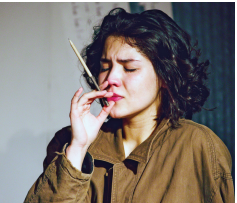
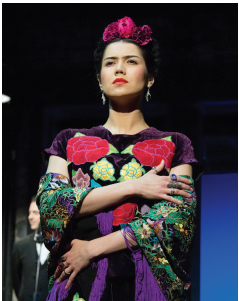
As Frida Kahlo in the play Frida. Life in Color, directed by Leila Abu-al-Kishek. Photo by Valery Myasnikov.
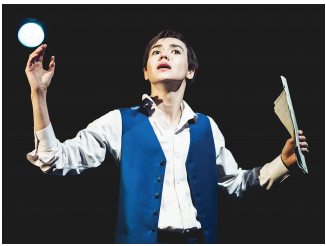
As Vaslav Nijinsky in the play Nijinsky. The Brilliant Idiot, directed by Leila Abu-al-Kishek. Photo by Olga Shvetsova.
— So, did you get good experience applying to a theatre school?
— I got objectively very solid training. Viktor Korshunov’s course was famous for its strong graduates, and there wasn’t a single student who got in “through connections.” That’s some kind of myth.
— Adelina, tell us about your film roles. You started out as a film actress, didn’t you? And you’ve done seven films?
— I started acting in films while I was finishing at the Shchepkin School. But there are four works I personally single out. For example, the war film I See the Target, where I played Mukha. To this day viewers still write to me about it. Then there’s the TV series To Marry Pushkin, where I had a fairly large supporting role — a kind of Cinderella-style love story with a guy who’s the son of an oligarch.
I’m really looking forward to the release this year of the multi-episode film Forgive, You Can’t Break Up and the feature film Wild League.
— Do you consider yourself a character actress? What is your type?
— If we’re talking about the role you saw me in today — in The Play That Goes Wrong — that’s a comedy. At the Vakhtangov Theatre we’ve already done three productions about the tragic fates of famous people: Vaslav Nijinsky, Frida Kahlo, Zelda Fitzgerald. I’m interested in the lives of geniuses, in understanding what inner contradictions my character faces. So I’m more of a dramatic, tragic actress.
— In the play Nijinsky. The Brilliant Idiot, the 2019 Vakhtangov Theatre premiere, you play a male role. How did that happen?
— It’s no secret that Vaslav Nijinsky was homosexual, and I wasn’t just playing a man. You could say I was playing a woman in a male body. According to descriptions, he really was very feminine, and his movement was like that of a cat. But we mustn’t forget — this is the stage of an academic theatre.
How do you show the love between two men in an academic theatre so that no viewer feels rejection? For us, it was very important to tell the story of a person and the development of his soul. It doesn’t matter whether that soul is in a male or a female body. The press did write that we had “bent to please the audience,” but that wasn’t true. We didn’t work from the head, we worked from feeling, from impulse. The director Leila Abu-al-Kishek and the choreographer Evgeniya Lyubashina, the creators of both Frida and Nijinsky, both graduated from ballet school.
For Nijinsky, the most terrifying thing was losing the ability to dance — just as it was for me when I suffered a spinal injury. Although now I’m involved in productions where I can make up for what I lost.
— The brilliant Diaghilev said that every era has its talents — the question is how to discover them.
— Yes, and huge thanks to our artistic director Rimas Vladimirovich Tuminas and to Kirill Igorevich Krok, our theatre director, for taking risks and giving young teams the opportunity to show themselves in the theatre. All of us are under 30 — the designer, the director, the playwright. This was our own initiative. We’re a team that came together in a single impulse to do something good, to become better ourselves — and that’s incredibly important. And there’s also memory: when we talk about such figures, it means they haven’t been forgotten.
— Adelina, you started your acting career at the Lenkom Theatre with Mark Zakharov. Why didn’t you stay there?
— When I graduated from the Shchepkin School in 2012, I was actually very successfully placed, even though failure had been predicted for me. In the end I was invited by both Mark Anatolyevich Zakharov and Rimas Tuminas. Rimas Vladimirovich was forming the First Studio of the Vakhtangov Theatre. So I found myself facing the most difficult choice of my life — although I should have been happy, I was actually crying and couldn’t decide.
If I had gone straight to the Vakhtangov Theatre, I would have lost forever the chance to try myself at Lenkom. And then I had a dream that hinted I could be a little bit cunning. The First Studio of the Vakhtangov Theatre was an experiment, a way of bringing graduates from other Russian theatre schools into the Shchukin tradition. It wasn’t yet clear what would come of it. I was being offered a salaried position, but there were several actors in the studio who were officially auditors — they weren’t paid, but they were allowed in. And I realized that being an auditor at Lenkom was impossible, while at Vakhtangov it was the opposite. So I asked Rimas Vladimirovich for permission to be an auditor in the First Studio and went to see what it was like at Lenkom.
A scene from the play Nijinsky. The Brilliant Idiot. Vaslav Nijinsky — Adelina Gizatullina. Photo by Olga Shvetsova.
— And the salary at Lenkom must be good, right?
— I’ve never really thought about salary… I’ve always been guided by creative considerations. And money, if a person is in their right place, will come. If a person lives honestly and moves in the right direction, it will come. Although we do have excellent salaries, knock on wood.
— What is your relationship with the stars of the Vakhtangov Theater? Lanovoy, Knyazev, Rutberg?
— You know, just before our final concert on Arbat in June, I was in the theater lobby warming up before my entrance. I was jumping, doing battements. And Vasily Semenovich Lanovoy came up to me, leaned against the wall without saying a word, and started doing battements too! And I said, “That’s what they should be filming, press—this, this is what needs to be captured!” I felt complete awe at being part of something alongside legends like Vasily Semenovich. Of course, they’re all different, complex, very strong, but I excuse every expression of theirs because they’re unique.
— You’re lucky!
— Absolutely! Rimas Vladimirovich Tuminas always says with tears in his eyes that the old generation of greats is leaving. Every season, we bury someone. And he set a goal to train new actors and directors who are in love with their work, with theater. I primarily feel myself as a theater actress.
We work, we created our own team in the 1st Studio of the Vakhtangov Theater, we “carved out” opportunities for ourselves. We have no wealthy parents, no sponsors, no lovers, none of that! We are people who want, who burn, and who work honestly.
— Adelina, did you ever want to dance on Broadway? With your ballet background?
— Well… I never had such thoughts or ambitions to go to America. Although I do love what they do in Hollywood. As Vladimir Alekseevich Andreev said when I was entering GITIS, “Look, here’s a Tatar girl, but with a completely Russian soul…” and indeed, those words apply to me.
— What is your generation, the 25–28-year-olds, like?
— I’m completely in love with our generation, and I fanatically believe that it is precisely us who can push Russia forward. If you like, we are the new generation of “sixty-niners,” romantics, and a new Silver Age. That’s us. The bursts of talented people in Russia now, making films, writing songs—they are 28–30-year-olds, to whom I belong.
I was born in 1991. We came of age in a transitional period, “mirroring” our parents, who perhaps lost something big they believed in. But at the same time, we stand firmly on our feet, and we are much happier than our parents were.
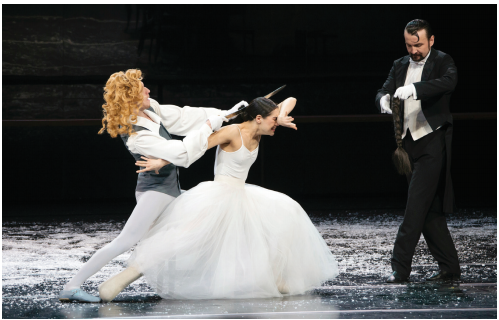
In the role of the Ballerina in the play Eugene Onegin, directed by Rimas Tuminas. Photo by Elena Kondratova.
In the role of Zelda Fitzgerald in the play Miss Nobody from Alabama, directed by Svetlana Medvedeva. Photo by Valery Myasnikov.
— What was Mark Zakharov’s favorite phrase?
— When we were rehearsing Heavenly Wanderers, he used to say: “The more barriers an artist has, the more their agility and inventiveness develop.” And if you perceive certain difficulties in life as just another barrier, the tragedy disappears. What remains is the thrill of the game. And that thrill sustains you, gives you the strength to fall and get back up.
— How do you manage to balance family and work? Your husband probably doesn’t have much to do with theater, so he has to wait for you…
— I am fanatically immersed in theater. Yes, my husband knew what he was marrying! I jokingly tell him that I became an actress before I became a wife and mother. And if I am happy, everything around me will sparkle and shine… Look, I’m away 350 days a year, 200 of those in the evenings, plus in addition to my theater repertoire I do The Show Went Wrong. All my husband can do is be ironic: sometimes a mustachioed woman with a unibrow comes home, sometimes a gay boy (hinting at Frida and Vaslav). But when I am home, I am home 100 percent, just as I am 100 percent in my profession.
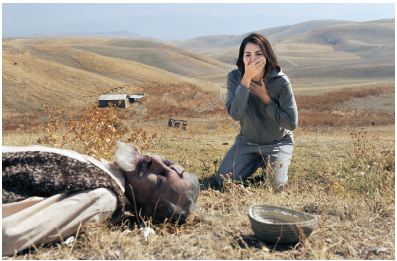
On the set of the TV series Cannot Forgive, Cannot Break Up, directed by Nikolay Borz.
— Adelina, what are your plans for the upcoming autumn season?
— We staged productions for two consecutive seasons at the Vakhtangov Theater — Frida and Nijinsky. And we will definitely continue working as a team, because the Vakhtangov Theater is one of the best theaters in Moscow. By September, Yuri Butusov’s production of Peer Gynt will premiere, in which I am rehearsing the role of Anitra. It’s a small role — I have two scenes — but I’m happy to work with Yuri Nikolaevich Butusov. Be sure to come!