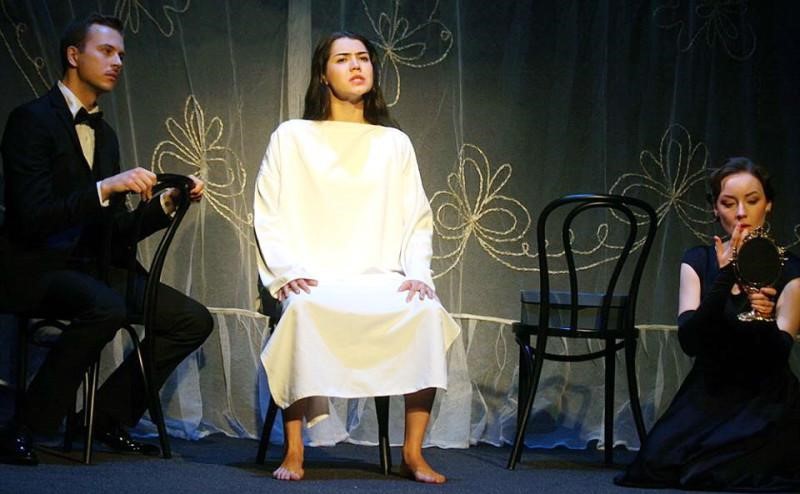
“FRIDA: LIFE IN COLOR”
Lev Rudsky April 5, 2018

At the State Academic Vakhtangov Theatre (Moscow, Russia), the premiere of the play “Frida: Life in Color” will take place on April 8 on the Simonov Stage. But today, April 5, a press preview and press conference for this new production were held—lucky for my journalist colleagues…
The play, based on Nika Simonova’s script “Frida: Life in Color,” tells the story of the world-famous Mexican artist Frida Kahlo and her husband Diego Rivera. Directed by Leila Abu-al-Kishk, the production explores the creativity of these two extraordinary people, their love, infidelities and separations, contradictions, disputes, and reconciliations. Everything that could happen in their lives—did happen. Yet nothing could destroy their creative partnership.
Director Leila Abu-al-Kishk says:
“Frida Kahlo’s art is inseparable from her life; most of her paintings are autobiographical. Her life is so full of events that it could inspire countless dramatic works. Each painting is a small play. Just days before her death, Frida painted Viva la Vida!—a title that resonates as a manifesto of her entire life, lived with gratitude despite numerous tragic circumstances. ‘Long live Life!’ Frida Kahlo says—no, asserts—at her farewell. The play Frida: Life in Color reveals what lies behind Frida Kahlo’s bright and, in part, naïve paintings. It is a story of loneliness, passion, pain, love, and destiny.”
Yes, playwright Nika Simonova has written a touching and poignant play about the Mexican artist, drawing on documentary materials, chronicles of her life, excerpts from Diego Rivera’s interviews, fragments of Frida Kahlo’s diary, and, of course, her own imagination and perspective on certain events. The production “Frida: Life in Color” will, to some extent, serve as a revelation for the audience, offering answers to important questions, and is sure to impress with both its sophistication and boldness.
The famous Mexican artist, whose name is sometimes linked to Salvador Dalí’s feminine alter ego, was extravagant and provocative, yet at the same time feminine and sensual. She endured many horrors in her life but always faced them with dignity, which is truly admirable. She limped due to polio contracted in childhood, but she never allowed herself to be underestimated and never despaired. After a terrible accident that seemed to leave no chance of survival, she managed to preserve her cheerful spirit and remained a captivating presence. The play explores both Frida’s character and her relationship with her husband Diego Rivera (more details on this will follow later in the piece).
“The story of this woman’s life,” says Nika Simonova, “is itself so dramatic, colorful, and complete that throughout our work on the production, it guided all of us—the author, director, lead actress, and the entire creative team—directing us and suggesting solutions. For me, Frida: Life in Color is, first and foremost, a story of perseverance and the triumphs of one small woman destined to become a great artist. It is a story of love and public solitude. A story of the victory of color over grayness, imagination over the mundane, life over death.”
During rehearsals, the young Vakhtangov actors invited Natalia Fortuny Jerez, Cultural Advisor at the Embassy of Mexico, who spoke to the cast and production team about her country, its culture and traditions, Frida Kahlo, her Casa Azul Museum, and the theatre scene in Mexico City. Ms. Fortuny wished the creators of the production success and explained that she did not expect a strictly factual biographical portrayal of the heroine, but that it would be extremely interesting for them to see what Russian actors think and feel about events that happened many years ago; a contemporary perspective is always fascinating!
All theatre staff express their sincere gratitude to Natalia Fortuny for her invaluable guidance during rehearsals.
Frida Kahlo is played by Adelina Gizatullina, her husband Diego Rivera by Denis Samoylov. Other cast members include Pavel Yudin (Leon Trotsky), Konstantin Beloshapka (Alejandro Arias), Polina Chernysheva (Singer), Anastasia Zhdanova (Cristina Kahlo), Natalia Vinokurova (Lupe Marín), Maria Volkova, Andrey Udalov, and others.
The production team includes production designer Dina Borovik, composer Nikolay Shipulin, choreographer Evgenia Lyubashina, and sound engineer Ekaterina Volkova.
The play features traditional Mexican music, recorded in the studios of the Vakhtangov Theatre. Sound engineering was handled by Ruslan Knushevitsky. Musicians on the recording include Mikhail Aynetdinov (trumpet), Nikolay Shipulin (guitar, bass, percussion, drums), Andrey Sergievsky (piano, synthesizer), and Jazira Abdigali (cello).
The performance has a running time of 2 hours and 30 minutes, including an intermission, and is recommended for viewers aged 16 and older (16+).