Family Secrets of Audrey Hepburn
The play I Created Audrey Hepburn on the “Studio” stage of the Vakhtangov Theatre

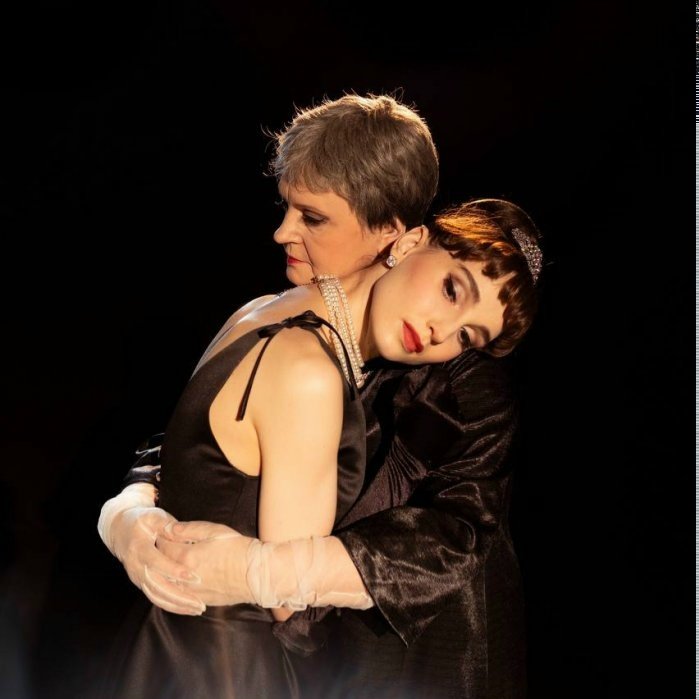
Do you know what kind of relationship the legendary Audrey Hepburn had with her mother, the Dutch baroness Ella van Heemstra? This question is explored in the recent premiere of I Created Audrey Hepburn on the “Studio” stage of the Vakhtangov Theatre. Director and actress Adelina Gizatullina wrote the play based on the autobiographical book Audrey Hepburn. The Life Told by Herself and staged it as director.
From the outside, the relationship between Hepburn and her mother seemed almost ideal, as suggested by the photograph hanging on the left side of the stage portal: a smiling, content mother and her obedient, well-mannered daughter. In reality, however, things were very different. In the very first scene, when the Baroness (Elena Sotnikova) arrives to visit her daughter, deeply distressed after her divorce from her second husband, a few sharply delivered questions are enough to push Audrey (Anna Chumak) to the edge of a nervous breakdown. The two women are separated by an invisible wall of misunderstanding. Its metaphor becomes a moving metal grille (set designer Eldar Abdurakhmanov); freed from her mother’s influence, Audrey says she has escaped from a “prison.” The Baroness is hurt and outraged. Yet an equal dialogue between mother and daughter never truly emerges. Why can two people so close fail to understand one another? Gizatullina suggests that the answer lies in Audrey’s childhood.
In fact, Hepburn never wrote memoirs. The book that inspired the play was compiled by a group of anonymous authors using the actress’s interviews and information from public sources. According to Gizatullina, who has admired Hepburn since childhood, she became “obsessed” with the idea of creating a play about the actress back in 2021 and chose the subject following the advice of Rimas Tuminas. Using the book as a starting point, Gizatullina created her own story. In her interpretation, Ella van Heemstra behaves far more harshly. For example, it is the Baroness who declares that Audrey lacks the qualities necessary to become a prima ballerina like Margot Fonteyn, whereas in the book this verdict belongs to ballet teacher Madame Rambert. The Baroness forces Audrey to meet her expectations at every turn. She mocks her daughter’s desire to dance in cabarets, dictates what is and is not acceptable for a proper lady, pressures her into accepting the Broadway musical that launched Hepburn’s acting career, demands sacrifices of personal happiness for professional success, and never praises her daughter.
In the tiny “Studio” space, which seats only thirty-five people, the actresses perform in immediate proximity to the audience: there is almost no scenery behind which they can hide. Their presence resembles film close-ups, where every gesture, turn of the head, and glance matters. Hepburn’s unrealized ballet career is echoed in the production’s physical language (choreographer Olga Logvina), reminiscent of a contemporary dance performance. The Baroness becomes its lead performer, while Audrey frequently illustrates her mother’s monologues and mirrors her costumes. The Baroness crosses the stage dragging a long train behind her like Phaedra, while her daughter’s “Chopin skirt” — a long romantic ballet skirt — is made in the same color (costume designer Alexandra Vakhrushina).
Elena Sotnikova’s Ella van Heemstra is a strong, self-assured, and at times authoritarian woman. She loves her daughter, yet keeps her under strict control in order to protect her from the mistakes she herself made in her youth. Gifted as an actress, Ella gave up the stage because of marriage. She left her first husband to be with Audrey’s father, the Englishman Joseph Hepburn-Ruston, but after discovering him in bed with Audrey’s nanny, she filed for divorce. She instills in her daughter the belief that the most important thing is to succeed professionally, build a career, remain strong, and never depend financially on anyone.
The mother never praised Audrey, fearing she might develop “star syndrome.” Every person loves and expresses love only in the way they know how. Ella van Heemstra loves her daughter deeply, yet cannot verbalize her feelings, considering emotional openness a form of weakness and sentimentality. Gradually, one begins to realize that the Baroness came to visit Audrey after her divorce in order to help and support her, but, unaccustomed to tenderness, once again reverted to criticism. Ella van Heemstra is unhappy in her own way, yet she does not know how to break through the wall that has arisen between herself and her daughter. It is no coincidence that Hepburn says in the book: “Mother loved me very much, but she did not always know how to show it… Life turned out in such a way that my mother became both mother and father to me.”
Anna Chumak, who plays Audrey Hepburn, bears a physical resemblance to her heroine. Having studied ballet herself, she looks striking in the elegant costumes, though this role still feels, as they say, “one to grow into.” There is still much for her to understand, master, and emotionally experience.
The production turned out dynamic, vivid, and highly relevant: afterward, one inevitably begins thinking about one’s own relationship with parents and recalling personal memories.
Contemporary theatre is constantly searching for new stories and heroes, which is why a fresh narrative on stage always attracts attention.
Text by Olga Romantsova