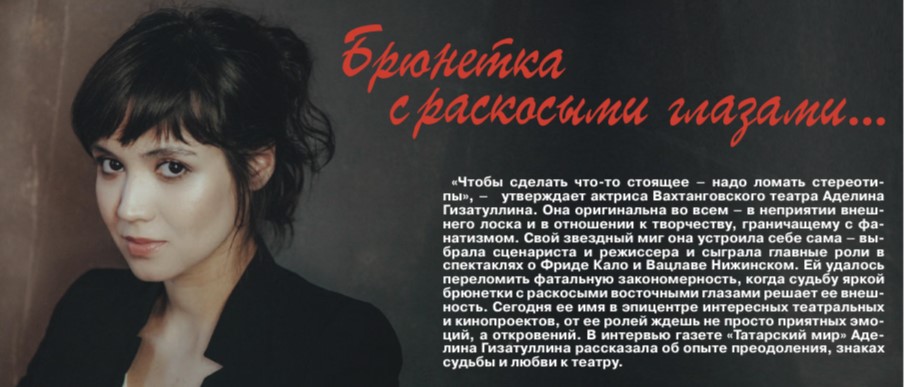
«A brunette with almond-shaped eyes…»
Leisan Sitdikova, December 25, 2019

— Adelina, you are an actress of the Russian repertory theatre and you live in Moscow. To what extent do you feel yourself to be Tatar?
— I have a Tatar name, and that cannot mean nothing. Tatar genes have probably influenced my character, my way of life, and relationships within my family. I was born in Srednekolymsk, in Yakutia. My father is a military officer, my mother is a doctor. We followed my father from one garrison to another. So my entire childhood passed “in the North”: Magadan, Norilsk, on the shore of the Arctic Ocean. When my father was demobilized, we settled in Dubna and were closely connected with the local Tatar community through our relatives. We traveled together to Kazan, went sightseeing, walked along Bauman Street and the Kremlin, admired the Kul Sharif Mosque. I was struck by how peacefully, beautifully, and tolerantly two religions—Islam and Christianity—coexist in that city. Kazan is a very bright and kind city. It is probably the only place in Russia, besides Moscow, where I could imagine myself living.
— Did you speak Tatar at home?
— Somehow it didn’t work out. Everyone around us spoke Russian, and at home it was simply easier for my parents to speak Russian with my brother and me. Though when they argued or scolded each other, they could switch to Tatar—and those scenes were very funny. In general, I understand Tatar, but I can’t really speak it. That is probably a shortcoming on my parents’ part.
— What led you to the acting profession? How did you realize that it interested you?
— We lived in the North, and my mother felt that without fruit and sunlight I was not developing well—skinny and rather weak—so I needed physical strengthening. She took me to many different clubs, but in the end I chose dance and dreamed of becoming a ballerina. When I was thirteen, I suffered a severe injury—a compression fracture of the spine. I simply fell off a step while getting out of a bus. At that moment, from the pain, I stopped breathing and thought I would die from lack of air. In one second my dream of ballet collapsed. Later, when we moved to Moscow in 2002, I joined a dance studio, but the only discipline I could attend for health reasons was acting. I was already “vaccinated” with the stage—I loved going out onto it. After thinking it through together with my mother, we decided that perhaps I could realize my need to dance and perform in front of an audience in dramatic theatre. And now I’m making up for lost time: I dance a lot on stage and am absolutely happy because of it.
— You studied at one of Moscow’s oldest theatre schools, the Shchepkin Theatre Institute, whose graduates include Oleg Dal, Inna Churikova, and Oleg Menshikov. Why did you choose this particular institution?
— Like all applicants, I auditioned everywhere possible, and generally I was allowed to move on to the next round almost everywhere—though always with reservations about my appearance, since it is not typical. I remember People’s Artist Vladimir Andreyev, who was recruiting students for his workshop at GITIS that year, saying that I was “a Tatar with a Russian soul.” At Shchepkin, I was sent to the third round three times. And each time, during the individual interview, I heard the same question: “What will you play in a Russian theatre?! Will there be a role for you in Russian—or even foreign—repertoire, since theatres need conventionally beautiful girls of Slavic appearance?!”
— It seems to me, Adelina, that your Eastern features are not as striking as, for example, those of actress Ravshana Kurkova, who is Uzbek and openly speaks in interviews about the enormous difficulties she faced in getting roles.
— I think my appearance has become more European over time. After the birth of my child, I changed outwardly—at least I want to believe so. But earlier there really was a very, very Eastern cast to my looks. And even now, on camera, you can see that my hair is bluish-black. In any case, at the entrance exams they were quite honest with me: it would be difficult to break into theatre not because I lacked talent, but because of such a specific appearance, such a type. I understood that it would be harder for me to advance and that I would have to work much more than others—that’s all. Three times at Shchepkin I was sent to the third round, and in the end they refused me outright. I took my documents to VGIK, hoping I would be accepted there. And then, a day later, suddenly they called from Shchepkin and said that someone hadn’t submitted their documents and a place had opened up for me. It was such a complicated story—and when I recall it, I say that was when my first gray hairs appeared. I was only sixteen. Quite a shake-up!
— How did you study?
— Studying was also difficult. They tried to beat the ballet out of me. At the course they nicknamed me Giselle. Even ordinary exercises I did with ballet arms and turnout, in first position. I had to get rid of that, because it interfered with organic existence on stage. And indeed, it took me a very long time to free myself from it. Though now I am beginning to cultivate it again—to remember, to revive it. While preparing for the play Nijinsky. A Brilliant Idiot, I worked with a teacher two or three times a week to tighten up my ballet technique. I think dance is another essential, very important means of expression for an actor. Why should I give it up?! Why should I renounce my ballet delicacy if it can express the director’s idea?!
— You studied under Viktor Ivanovich Korshunov, a legendary figure of the Maly Theatre. What did he teach you?
— One of my most successful works at the Shchepkin Theatre School was the role of Masha in The Seagull, directed by Korshunov’s son, Alexander Viktorovich, to whom I am very grateful. After the premiere, Viktor Ivanovich came up to me, affectionately patted my cheek in approval, and said that I had learned a very important thing: to analyze and comprehend the value of every spoken phrase, every turn of the head on stage. This is one of his guiding principles that I took as the foundation of my work. Unfortunately, due to his age and health, Viktor Ivanovich did not often attend our classes, but every word he said I have remembered for the rest of my life.
— Were you trained very strictly?
— Well, with my fragile nature, it seemed to me that I was treated quite harshly. But on the other hand, it gave me a certain foundation for the future.
— So your studies added a few more gray hairs?
— Something like that. My ballet discipline saved me: if you are being scolded, it means you are noticed, and therefore expected to deliver more.
— After graduation, you were very well placed — you joined Lenkom…
— It wasn’t that simple. At that moment, I was probably facing the main choice of my life. I was accepted both to Lenkom and to the first experimental studio of the Vakhtangov Theatre. I could never have expected that. I thought my case would be a placement in some theater at the end of a subway line. I didn’t sleep at night, I cried, and I didn’t understand what I should do. And in a kind of half-fainting state, I decided that I had to go to Lenkom and remain a guest auditor at the Vakhtangov studio. If I had stayed on staff at Vakhtangov, I would never have made it to Lenkom — I would have missed that opportunity forever. After all, we all grew up watching Mark Anatolyevich Zakharov’s films and performances and admired his directing immensely.
— Mark Zakharov was a master of saying unserious things with a serious face. The line from That Very Münchhausen — “Smile, gentlemen!” — became a refrain of his life and theater.
— He was a special person, that’s true. I took part in rehearsals for Heavenly Wanderers, saw how the performance was born, and how great actors like Alexander Baluev, Alexandra Zakharova, Viktor Rakov, and Ivan Agapov worked. During rehearsals, Mark Anatolyevich joked that the more barriers an artist has, the higher their ability to jump and invent becomes. And I think this is now my own motto. It is a great happiness that barriers exist — they force you to think and act unconventionally. I wish Lenkom only the best, because its troupe is extraordinary. The theater suffered a great loss with the passing of Mark Anatolyevich, yet it was and remains one of the best theaters in the country.
— How did your final transition to the Vakhtangov Theatre happen?
— Once I went to a Kusturica concert with a friend and felt inspired to work. I called my acquaintance from Shchepkin, director Svetlana Medvedeva, and suggested staging a performance on the experimental stage about Zelda Fitzgerald — a talented dancer, artist, and wife of writer Scott Fitzgerald. In the summer, we showed it to the artistic director of the Vakhtangov Theatre, Rimas Tuminas. He liked it, but said he couldn’t release the production because I was an actress of another theater. I had to make a decision. Back then, I couldn’t even imagine that my portrait would one day hang in the foyer of the Vakhtangov Theatre — and now that is a reality.
— Then came two more productions: about Vaslav Nijinsky and Frida Kahlo on the Simonov Stage, where you played the leading roles…
— Yes, but not immediately. There was a break — I got married and had a daughter. For some time, I continued to perform in Miss Nobody from Alabama about Zelda Fitzgerald, but at some point I no longer found my performance in the repertoire. When I asked Tuminas where it had gone, he reacted rather sharply: “What, are you an actress of just one role? Do something else!” I called my former classmate, poet and playwright Nika Simonova, who had also just had a child and was on maternity leave. She noticed similarities between my biography and Frida Kahlo’s and began writing a play. The director was another mutual friend, Leila Abu-al-Kishek, and the set designer was my acquaintance from Lenkom, Dina Borovik. As I mentioned earlier, I too experienced an accident in childhood and spent a long time immobilized. The play includes the line: “I am seventeen, but I smell like an old woman, because I soil myself.” These words include my own experience — I spent two months confined to a hospital bed. I was not allowed to get up, and sometimes nurses wouldn’t empty the bedpan standing next to my bed all day. For a girl who had spent her entire childhood at the ballet barre listening to classical music, this was a terrible drama. But it gave me the chance to fully express this experience in the role of Frida Kahlo, who lived a difficult life filled with tears, losses, joy, turmoil, and yet managed to preserve an immense love for life and great strength of spirit.
— As for the next production, weren’t you afraid to take on the role of Vaslav Nijinsky, given the complexity of transforming into a male character?
— I became familiar with Nijinsky’s biography quite a long time ago, and it deeply resonated with me. I understood that this had to be done, that it was relevant and necessary. But even in my boldest dreams, I could never have imagined that I would myself play the role of the great ballet artist. It was my mother who suggested the idea: “How can you express the love between two men so that no one in the audience feels rejection? Only if Nijinsky is played by a woman.” Later, while researching with the director and screenwriter, we found confirmation in many books that Vaslav Fomich was an incredibly subtle, gentle person; even his dance plasticity was filled with feminine energy. Nijinsky, in his search for eternal beauty, simply could not digest the filthy, boiling cauldron of human passions within himself — the conflict between what he felt and the tragic break with Diaghilev, which almost coincided with the horrors of the First World War. When he stopped dancing, life ended for him. Nijinsky descended into madness, fell silent for many years, and no longer knew how to respond to reality. The creators of the performance believe that this was his weakness — one must not give up, one must fight in any situation. And yet, we love and adore Nijinsky.
— The production is incredibly popular; tickets are always sold out. That means you truly hit the mark.
— You know, recently I was on tour in Paris. I went to the Montmartre Cemetery and met an elderly couple there who come twice a year to care for Nijinsky’s grave. Just five minutes before I arrived, they had planted fresh flowers. It was as if Nijinsky had dressed up for my visit.
Later, near the Théâtre du Châtelet, I stopped by a café for lunch. I sat down at a table and only then realized that I was in the Café Sarah Bernhardt, surrounded by her portraits on the walls. I had hesitated for a long time about daring to play a man, because once I had read a theater critic saying that only Sarah Bernhardt could allow herself to play Hamlet. I doubted for a long time whether I should even begin this project.
And whenever fears overwhelm me, I receive many gifts and signs from the universe. It means it’s possible! The universe itself tells me: don’t doubt it — everything will work out.
— So it turns out that there is a place for a Tatar actress in Russian theater after all! This season you are performing in the premiere of Peer Gynt, directed by Yuri Butusov, on the main stage of the Vakhtangov Theatre. How did you come to work with this remarkable director?
— I still can’t quite wrap my head around the idea that someone might invite me somewhere. And suddenly Yuri Nikolaevich invited me to audition for the role of Anitra — Solveig’s antagonist — in Peer Gynt. During rehearsals I was in an awful state of tension. I would come in and be unable to say a single word.
I play Frida, the audience applauds, there are flowers, good reviews — and then I come to Peer Gynt rehearsals and feel completely frozen. I see a genius in front of me, my dream seems to be coming true, and I’m not ready for it.
In the end, we tried different versions of my scenes. And I felt like a real actress — true material for the director’s creative flight. It’s an incredible feeling when you can trust a director completely in all his proposals, and out of love and admiration do everything he asks. As a result, we formed a wonderful team, and I bow deeply to everyone for that.
— Another major project featuring you was released this year — the film about the origins of Russian football, The Wild League, where you played Malika, the beloved of the main character. Tell us a bit about your character. What was it like working alongside such a star-studded cast — Vladimir Yaglych, Dmitry Nazarov, Ivan Okhlobystin, and Olesya Sudzilovskaya?
— The launch of this project took a very long time, and I came to auditions for almost a year. All that was clear was that Malika, the character I was to play, was an Eastern girl of unclear origin. Together with my vocal coach, we came up with the idea that at the very beginning of the film she would sing the Tatar folk song “Ay, Bylbylym.” That’s how my character became a Tatar woman.
In any case, the plot shouldn’t be taken too seriously — it’s a fairy tale. I was nervous for a long time, because I had never before worked in film alongside actors of this caliber. But my worries were in vain. Dmitry Yuryevich Nazarov, a student of my teacher Korshunov, immediately took me under his wing. I felt his acceptance right away; we talked a lot about the Sphere Theatre and the Korshunov dynasty.
Ivan Ivanovich Okhlobystin, whom I previously knew only from TV series, revealed himself to me in a completely new way. He is a person of astonishing purity and modesty — no trace of star behavior. Vladimir Yaglych brought remarkable directorial ideas: he turned our love scene in the boat into shots of extraordinary visual beauty. And how Olesya Sudzilovskaya supported me, seeing how young and inexperienced I was! She would come up to me and whisper in my ear: “Everything is fine, you’re doing great!”
As for working with the Americans involved in the project — I won’t even begin: such organization, dedication, and attentiveness to every single person I had never encountered before. The Wild League was a big, beautiful experience for me.
— And still — the theater stage or the film set? Where do you feel more comfortable, where is the greater magic?
— I enjoy working on film, and every project leaves a warm feeling in my heart, but I have never bet on cinema. Theater is so important to me that I don’t actively push myself in film at all. I have an agent — if I’m invited to shoot, I go.
But I am deeply in love with this mad theatrical process: rehearsals, inventing scenes, late-night phone calls, and the team work, when boundaries between actors, director, and designer dissolve. I love this openness, this youthful spirit of theater.
In cinema, I am still mostly offered roles of Eastern girls: Aygul, Malika, Leila — I suppose that says it all. Theater stages and makeup allow me to step out of this narrow corridor, and I know that I am ready for something greater.