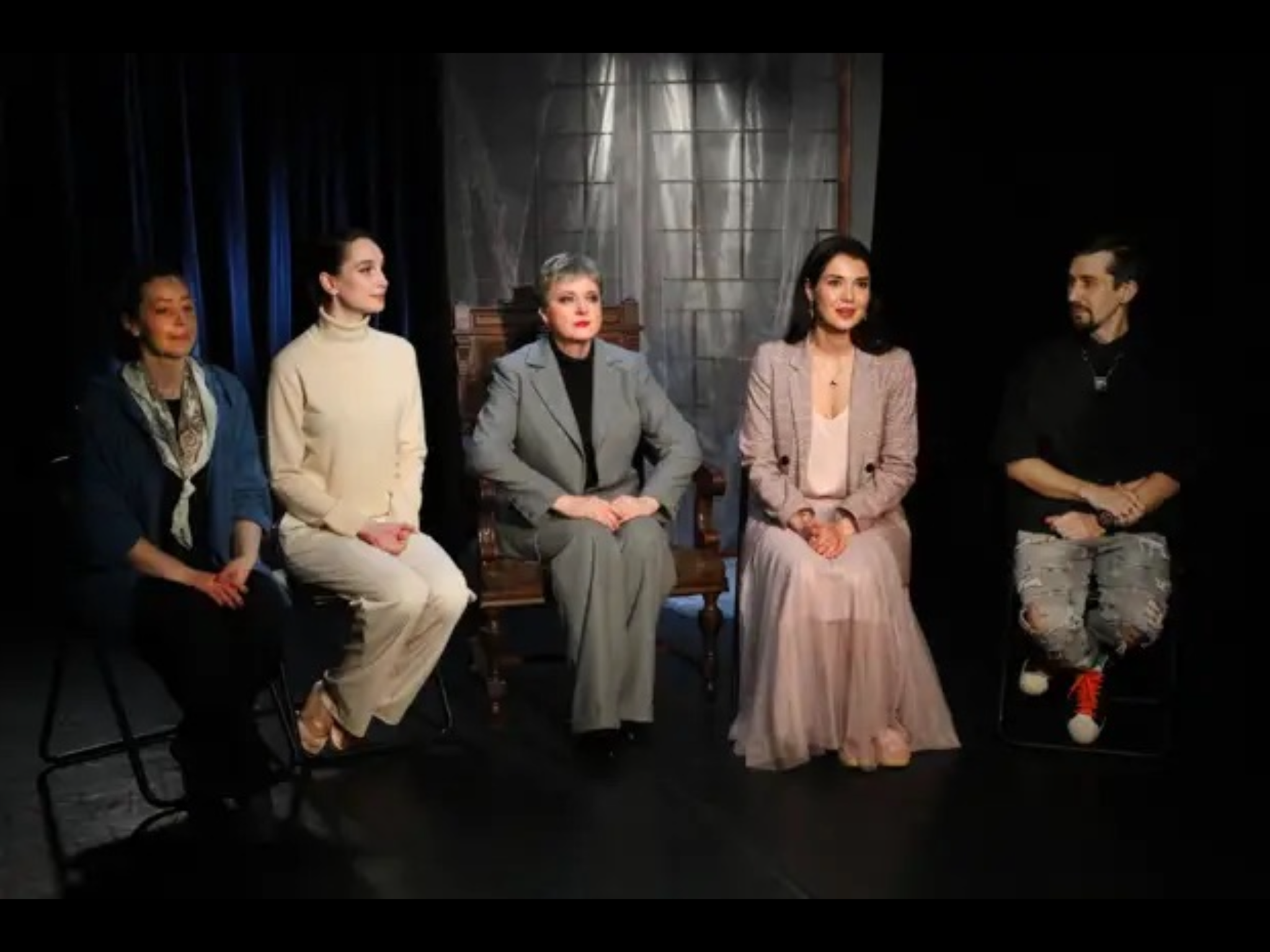
Dialogue Beneath the Spotlights
At the Vakhtangov Theatre’s Studio Stage, the play I Created Audrey Hepburn has premiered.

This production marks the directorial and dramaturgical debut of Adeline Gizatullina, a graduate of the Shchepkin Theatre School. In January 2014, she joined the First Studio of the Vakhtangov Theatre, and four years later became a member of the theatre’s main company, where she worked until 2024.
Among Gizatullina’s most notable stage roles at the Vakhtangov Theatre were Frida Kahlo in Frida. Life in Color, Vaslav Nijinsky in Nijinsky. Brilliant Idiot, Anitra in Peer Gynt directed by Yury Butusov, and Zelda Fitzgerald in Miss Nobody from Alabama. In productions by Rimas Tuminas — Eugene Onegin and War and Peace — she portrayed the Ballerina and Mademoiselle Bourienne.
In 2024, Gizatullina graduated from the directing department of the Moscow Film School and proposed staging her own play, I Created Audrey Hepburn, at the Vakhtangov Theatre. Rimas Tuminas encouraged her to write the story herself rather than search for another playwright. She developed the play together with renowned Vakhtangov actress, Honored Artist of Russia Elena Sotnikova.
The premiere took place on April 27, 2026, on the Studio Stage.
“The story of the play,” says the young director, “is born from the difficult relationship between Audrey Hepburn and her mother, Baroness Ella van Heemstra. Although it is based on real events from the actress’s life, the central figure becomes the mother who ‘created’ Audrey.”
What is true maternal love — unwavering support, or the demand to obey? Complete acceptance, or the desire to reshape another human being? Gizatullina undertakes an exploration of one of drama’s most difficult eternal questions.
Yet she rejects the role of detached researcher:
“I ask these questions as a director searching for living truth within human relationships. The world knows Audrey Hepburn as an actress, a style icon, an Academy Award winner. But very few know what she truly dreamed about. I believe this story will resonate not only with women — men, too, will recognize themselves in these characters. I was fascinated by Audrey as a child, and I still admire her today. She was a woman of extraordinary purity and kindness.”
Audrey Hepburn (May 4, 1929 – January 20, 1993) was born in Belgium and spent her childhood in Arnhem, in the Netherlands, during Nazi occupation in World War II. Her mother, Baroness Ella van Heemstra, was a Dutch aristocrat. Her father, Joseph Hepburn-Ruston, abandoned the family in 1935, deeply traumatizing six-year-old Audrey.
She studied ballet before moving to London in 1948, where she began working as a dancer. After appearing in several films, she caught the attention of Colette, who selected her for the leading role in Gigi on Broadway.
Her greatest film performances include Roman Holiday, Sabrina, Breakfast at Tiffany’s, Funny Face, Charade, and How to Steal a Million. In 1956 she portrayed Natasha Rostova in War and Peace directed by King Vidor — a performance many admirers still consider deeply faithful to Tolstoy’s heroine.
Beautiful, sincere, charismatic, and warm-hearted, Hepburn enchanted co-stars, audiences, and critics alike. She won the Academy Award for Best Actress for Roman Holiday. Leaving cinema and theatre at the height of her fame, she became an international ambassador for UNICEF, dedicating herself to helping children in Africa and South America.
Like Audrey Hepburn, Adeline Gizatullina dreamed of becoming a ballerina as a child. Life redirected her path toward theatre. Born in Yakutia, she entered the Shchepkin School in Moscow under People’s Artist of the USSR Viktor Korshunov, eventually joining the Vakhtangov Theatre company.
The production draws heavily from Confessions of Love, a compilation of Hepburn’s interviews and reflections. One of the book’s most painful threads concerns Audrey’s longing for parental approval. After the success of Roman Holiday, she desperately wanted her mother to admire her performance in The Nun’s Story — but “her mother remained cold.”
Years later, Audrey’s partner Robert Wolders tried to explain:
“Your mother loves you very, very much. She simply doesn’t know how to say it.”
Audrey burst into tears:
“Then let her just say it. I’ll understand.”
But by then her mother was already gravely ill, and those words were never spoken.
The play begins with confrontation. Audrey Hepburn (Anna Chumak) is unexpectedly visited by Baroness van Heemstra (Elena Sotnikova), who learns that her daughter has separated from her second husband, Italian psychiatrist Andrea Dotti. The mother immediately begins “educating” her fifty-year-old daughter. Audrey finally erupts, accusing her mother of imprisoning her for a lifetime within impossible expectations.
What follows is a deeply theatrical dialogue beneath the spotlights — a wounded mother accusing her daughter of ingratitude, and a daughter struggling to defend herself. Both women desperately try to understand when and why the bond most precious to them began to collapse.
The production’s visual world, created by set designer Elzar Abdrakhmanov and lighting designer Alexander Matveev, is minimalist yet expressive. Transparent curtains divide the stage, a hanging microphone suggests performance and exposure, and a recurring iron-bar motif evokes the “prison” Audrey describes. At the center stands a throne-like chair perfectly suited to the Baroness.
Costume designer Alexandra Vakhrushina dresses the Baroness in elegant aristocratic fashions of the 1980s, while Audrey appears in flowing white and black silhouettes, ballet attire, tunics, and delicate ballet flats.
Gradually, the mother’s rigidity softens. Her authority gives way to doubt, while Audrey begins to feel compassion for her mother. Their physical interactions increasingly resemble dance — sometimes ballet — enhanced by choreography from Olga Logvina and music by composer Andrey Bulatov.
And eventually, words themselves become unnecessary. In silence, Anna Chumak conveys the immense loneliness and tragedy of Audrey Hepburn’s life — a life shaped, and wounded, by the people closest to her.
By the end, the audience cannot fully side with either woman. Compassion belongs to both.
By Nina Kataeva
Photos by Vladimir Korobitsyn